
Introduction
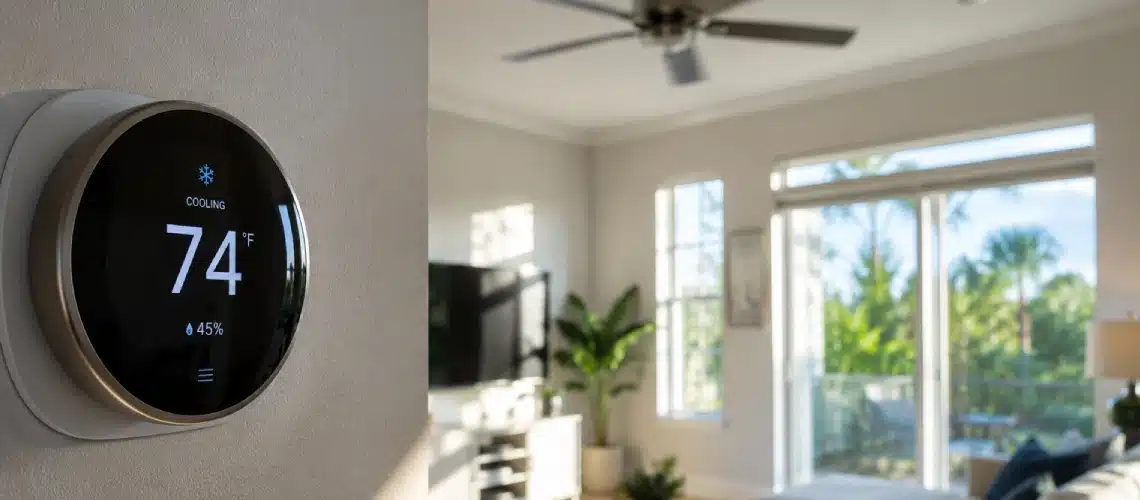
Your AC is doing its job. The thermostat reads 74. The system kicks on. The system kicks off. Repeat.
So why does your home still feel sticky?
This is one of the most frustrating situations in a Florida summer because nothing looks broken. The technician says the system is working. The temperature is correct. The vents are blowing cold air. And yet, by mid-afternoon, the kitchen feels heavy. The bedrooms feel slightly damp. Your skin never quite dries.
There is a real reason for this, and it has very little to do with whether your AC is “working.”
Quick Answer
A Florida home can feel sticky with the AC running because air conditioning and humidity control are technically two different jobs.
AC cools the air, known as sensible cooling, and removes moisture as a side effect, known as latent cooling. When an AC system is oversized or short-cycling, it cools fast but never runs long enough to remove enough humidity.
The result is a cool house that still feels uncomfortable.
Quick Answers (Common Questions)
Why does my house feel humid with the AC on?
Because cooling and dehumidifying are two different processes. Your AC handles both, but only when it runs long enough for moisture to condense on the cooling coils and drain away.
Is my AC broken?
Probably not. The more common cause is an oversized AC, a system designed for temperature only, or a sealed home that needs mechanical ventilation.
Should I just buy a dehumidifier?
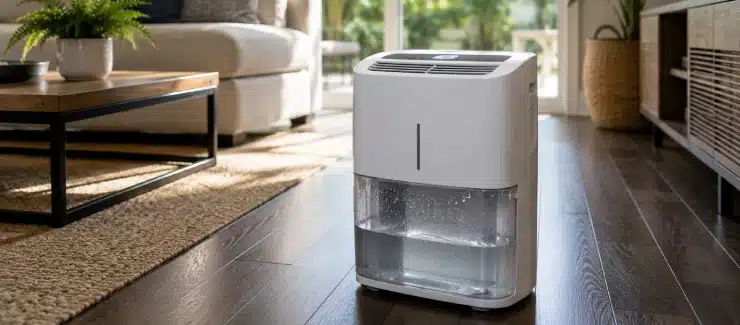
A dehumidifier helps, but it does not fix the root cause. Identifying whether the issue is AC sizing, ventilation, or the building envelope first saves you from buying the wrong solution.
Does this damage my home over time?
Yes. Indoor humidity above 60 percent can support mold growth, dust mites, and pest activity. Constant exposure can also damage wood, insulation, and electronics.
According to EPA indoor air quality guidance, indoor relative humidity should be kept below 60%, ideally between 30% and 50%, when possible. Higher humidity can create conditions where mold growth becomes more likely.
In Florida climates, maintaining humidity closer to 50% is often necessary to prevent indoor air issues.
Why AC Alone Does Not Fix Humidity
Here is the simple version:
Your AC cools fast, but it is not running long enough to remove moisture.
Here is what that means in detail:
Air conditioning was built to cool air. Dehumidifying happens as part of the cooling process, but it is not always enough on its own.
Warm humid air passes over a set of cold coils inside your AC unit. The moisture in the air condenses on those coils, just like water beads on a cold drink glass. The water then drips into a pan and drains outside. Cool, drier air blows back into the house.
This works only when the AC runs long enough for moisture to actually condense. The cycle usually needs about 15 to 20 minutes of continuous run time during peak humidity to do the job.
Here is where many Florida homes hit a wall: their AC is too big.
In the rush to keep up with Florida heat, contractors sometimes install AC units one size larger than the home actually needs. A bigger system cools faster. It can also short-cycle, meaning it runs for 5 to 8 minutes, hits the temperature target, and shuts off.
The air gets cold. The humidity stays.
Your system may not be broken. It may be too powerful for the temperature work and not running long enough for the humidity work.
This article explains why your home feels sticky. For full indoor air quality testing, see our Indoor Air Quality Testing Services in Florida page.
If moisture or microbial growth is suspected, refer to our Mold Testing Services in Florida page for detailed testing.
If indoor materials, new furniture, paint, or recent renovation may be contributing, see our VOC Testing Services Florida page.
Indoor Humidity Levels and What They Mean
| Indoor Humidity Level | Meaning |
| Below 50% | Ideal indoor condition |
| 50–60% | Acceptable range |
| Above 60% | Mold growth risk |
A single humidity reading does not tell the whole story, but it gives you a useful starting point. If multiple rooms stay above 60% while the AC is running, the home needs a closer look.
The Other Three Culprits
Even if your AC is sized correctly, these factors can still keep humidity high:
Old or Dirty Coils
Dust and biological film on AC coils reduce their ability to condense moisture. A coil that has not been cleaned in three to five years may be significantly worse at dehumidifying than the same coil when clean.
No Mechanical Ventilation in a Sealed Home
Many newer Florida homes are sealed tightly for hurricane protection and energy efficiency. Without an ERV, HRV, or another controlled ventilation strategy, humid air and indoor pollutants may linger longer than homeowners expect.
Concentrated Humidity Sources Inside
Cooking, showering, indoor plants, aquariums, and laundry release moisture that the AC has to remove on top of the outdoor humidity coming in.
In a home with weak dehumidification, these sources add up quickly.
Any combination of these can turn a “working” AC into a system that cannot win the humidity fight.
Why This Is Common in Central Florida Homes
Sticky indoor air is common in Florida because outdoor humidity remains high most of the year, creating constant moisture pressure on the home.
These humidity-related issues are especially common in Central Florida areas like Orlando, Tampa, and surrounding regions where moisture levels remain high throughout the year.
This is why thermostat readings alone can be misleading. A home at 74 degrees may still feel heavy, damp, or stale if the humidity is sitting above a healthy range.
Florida homes also face a mix of challenges that make this worse: tightly sealed construction, frequent AC use, short cooling cycles, humid outdoor air, indoor moisture sources, and rooms that do not dry out evenly.
That combination can create indoor air that feels wrong even when the AC appears to be working.
A Real-World Scenario
Consider a couple in Tampa. They bought a 2019-built home. The builder included a four-ton AC for what turned out to be a 1,900 square foot house. By Florida sizing standards, the home needed closer to three tons.
In May, everything felt fine. By late June, the master bedroom and walk-in closet started feeling muggy. By July, the couple bought two portable dehumidifiers. They helped a little. The kitchen still felt heavy after cooking. The master closet smelled faintly off.
The AC was working perfectly. It was also too big to ever run long enough to dehumidify properly. They had a hygrometer reading 67 percent in the closet.
Targeted air quality testing identified high humidity, elevated airborne mold spores compared to outdoor baseline, and no visible mold yet. They installed a whole-home dehumidifier. The closet readings dropped to 52 percent. The smell disappeared. No remediation was needed because they caught it early.
The expensive version is the same homeowners ignoring it for two more summers, then discovering mold inside the closet wall.
Expert Insight
“In Florida, an AC running constantly does not mean the system is solving the humidity problem. We see homes every week where the temperature is fine and the humidity is in the mold-risk zone. The two readings tell different stories, and most homeowners only check one.”
Lynn Campbell, CIEC
Certified Indoor Environmental Consultant
Evergreen Air Quality Services, Florida
Signs Your AC Is Not Winning the Humidity Fight
These are practical, observable signals. Two or more is meaningful.
-
AC cycles under 10 minutes
-
Home cools quickly but feels muggy
-
Some rooms feel stickier
-
Humidity above 60%
-
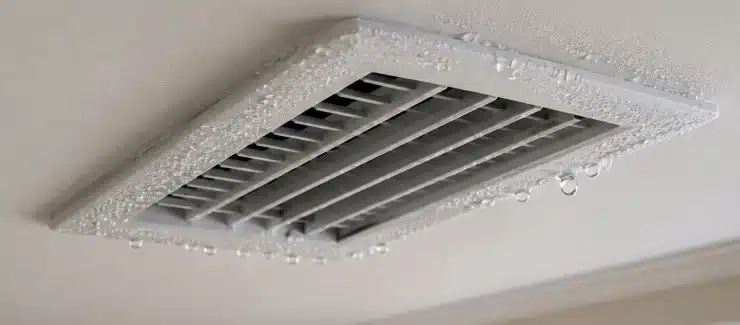
Condensation on vents
-
Musty smell when AC starts
-
Symptoms worse indoors
When Testing Makes Sense
If your AC is running but the air still feels off, testing shows why.
We test only. No HVAC sales. No remediation.
You get clear data on humidity, mold activity, and VOC levels.
Why This Matters
The Florida normalization problem is not just about comfort. It is about cost.
Many homeowners try several fixes before testing the air: a new thermostat, AC tune-up, portable dehumidifier, air purifier, or duct cleaning. Each may help in the right situation, but none confirms the actual cause.
Testing first shows whether the issue is humidity, microbial activity, VOCs, ventilation, or a combination. That difference matters because a humidity or ventilation fix is very different from a mold-related issue that requires further action.
Disclaimer
This information is for educational purposes and does not replace professional indoor air quality testing. Testing provides verified data specific to your home.
FAQ
Can an AC be too big for a Florida home?
Yes, and it is one of the most common installation issues in the state. An oversized AC cools quickly but does not run long enough to remove humidity, leaving the home cool but sticky.
How can I tell if my AC is short-cycling?
Time it. If your AC kicks on and off in cycles under 10 minutes during peak afternoon heat, it is likely short-cycling. Proper Florida cycles should run 15 to 20 minutes during high humidity.
Will a smart thermostat fix this?
Sometimes partially. Some smart thermostats have a dry mode or humidity control feature that runs the AC longer at slightly higher temperatures to remove moisture. It helps. It does not fix oversizing.
Do I need a whole-home dehumidifier?
If your humidity stays above 60 percent in multiple rooms with the AC running properly, a whole-home dehumidifier may be worth considering. Testing confirms whether the cost is justified before you spend money installing one.
What does air quality testing actually find that I cannot see?
Airborne mold spore counts compared to outdoor baseline, VOC levels, humidity room by room, particulate concentrations, and indicators of microbial activity inside walls or ducts.
Is mold testing the same as IAQ testing?
No. Mold testing focuses on microbial growth specifically. IAQ testing covers a broader range including humidity, VOCs, and particulates. Your symptoms determine which one fits.
Should I run my AC during testing?
Yes, normal operating conditions give the most accurate picture of what your family actually breathes day to day.
Final CTA
If your AC runs all day and your Florida home still feels sticky, the issue is not always the AC. Testing identifies where the humidity is concentrated and what your air actually contains, so you spend on the fix that matters.
Schedule indoor air quality testing in Central Florida homes.
Certified lab results in 24 to 48 hours.
Call 407-625-4458 or book online.
About the Reviewer
Lynn Campbell is a Certified Indoor Environmental Consultant, CIEC, serving Florida. She specializes in indoor air quality testing, humidity-related conditions, and environmental analysis in high-moisture climates. Her work focuses on independent assessments without HVAC sales or remediation services.
