

You clean your home. You vacuum. You wipe every surface. Yet you still wake up sneezing.
In Florida’s subtropical climate, household dust is not simply dirt. Humidity, airflow, long HVAC run times, and modern building design can turn ordinary dust into a biological reservoir that circulates through your breathing zone every day.
At Evergreen Air Quality Services, we provide only independent indoor air quality testing and laboratory analysis. We do not perform cleaning, duct services, or remediation. Our role is to identify measurable airborne contaminants so homeowners can make informed decisions without feeling pressured to buy additional services.
If your symptoms improve when you leave home but worsen when you return indoors, your indoor air may be contributing.
In This Article
-
What causes dust allergies in Florida homes
-
Why Florida homes trap airborne allergens
-
How HVAC filters affect indoor dust levels
-
Symptoms linked to indoor dust exposure
-
Hidden dust sources that trigger allergies in Florida homes
-
Why independent indoor air quality testing matters
-
How to reduce dust allergens indoors
-
When to schedule indoor air quality testing for Florida homes
Quick Takeaway
-
Indoor humidity above 50 percent allows dust mites to thrive
-
PM2.5 and other airborne particulate matter can remain suspended and recirculate through HVAC systems
-
Testing provides measured environmental data, not guesswork
What Causes Dust Allergies in Florida Homes?
Dust allergies in Florida homes often result from dust mites, pet dander, pollen, and fine particulate matter circulating through HVAC systems in humid indoor environments.
Florida’s climate creates ideal conditions for indoor allergen accumulation. High humidity, year-round air conditioning use, and tightly sealed building envelopes allow fine particles and biological allergens to remain indoors longer than they often would in drier regions.
1. The Biological Reality of Dust Allergies in Florida Homes
Dust in Florida homes is hygroscopic, meaning it absorbs moisture from the air. When relative humidity exceeds 50 percent, ordinary dust can support conditions that increase allergen exposure.
Indoor dust can also contain bioaerosols, allergen proteins, microbial fragments, and airborne particulate matter that accumulate within enclosed environments.
Common components include:
-
Dead skin cells
-
Dust mites
-
Pet dander
-
Fabric fibers
-
Pollen
-
Bacteria
-
Fine particulate matter
Dust Mites and Allergen Proteins
Dust mites are microscopic arachnids that thrive in humid conditions. Their waste contains allergenic proteins, including Der p 1, a well-known trigger associated with dust allergies in Florida homes.
PM2.5 and Indoor Exposure
Fine particulate matter, or PM2.5, refers to particles smaller than 2.5 microns in diameter. The EPA regulates outdoor PM2.5 exposure under the National Ambient Air Quality Standards.
Because these particles can bypass much of the body’s natural filtration and penetrate deep into the lungs, indoor PM2.5 is an increasing concern in tightly sealed homes. In Florida homes with long AC run times and frequent air recirculation, PM2.5 can remain suspended for extended periods unless captured by effective filtration.
2. Why Florida Homes Trap Allergens
Florida construction often prioritizes energy efficiency and climate control. That helps with comfort, but tighter building envelopes can also reduce natural air exchange.
The Humidity Threshold
Maintaining indoor relative humidity below 50 percent is one of the most effective ways to limit dust mite survival and allergen accumulation. Without a hygrometer, homeowners are estimating rather than measuring.
When moisture problems occur inside walls or flooring, moisture assessment and environmental evaluation can help identify hidden humidity sources.
HVAC Recirculation Effect
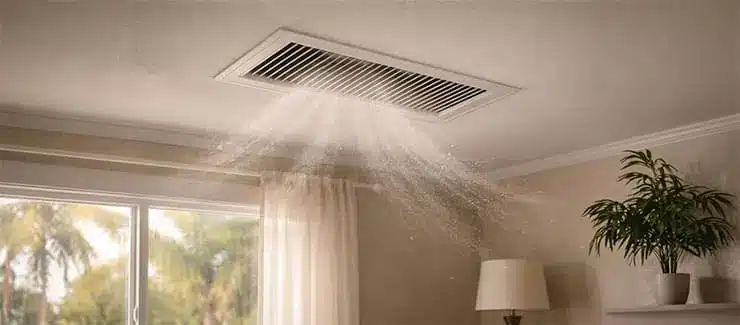
Air conditioning systems continuously recirculate indoor air. If filtration is inadequate, the HVAC system can redistribute fine particles from room to room instead of removing them.
When filters are overdue for replacement, poorly fitted, or rated too low for fine particle capture, allergen concentrations may remain elevated. In Florida, where systems often run for much of the year, that recirculation effect matters even more.

3. The HVAC Filter Standard: Why MERV Ratings Matter
Not all filters are designed to protect occupants. Many entry-level filters are primarily intended to protect equipment.
Understanding MERV ratings is critical:
MERV 8
Captures larger debris such as lint and visible dust. Provides limited protection against finer airborne allergens.
MERV 11
Captures smaller dust particles and pet dander. Often suitable for balanced residential systems.
MERV 13
Often recommended for allergy-sensitive households because it can capture finer airborne particulate matter, including PM2.5-sized particles, smoke, and microscopic debris. However, it must be compatible with the HVAC system’s airflow capacity to avoid static pressure problems.
Filter upgrades should always be confirmed with a qualified HVAC professional.
4. Common Symptoms Linked to Indoor Dust Exposure
Persistent indoor allergen exposure may contribute to:
-
Sneezing
-
Nasal congestion
-
Runny nose
-
Itchy or watery eyes
-
Coughing
-
Wheezing
-
Headaches
-
Fatigue
Children, older adults, and people with underlying respiratory sensitivities may be more affected.
Indoor air testing provides environmental measurements. It is not a medical diagnosis. If symptoms persist, consultation with a healthcare provider is appropriate.
A practical pattern to notice is this: if symptoms improve when you leave home but worsen when you return indoors, environmental triggers may be contributing.
5. Hidden Dust Sources That Trigger Allergies in Florida Homes
Even well-maintained homes can contain overlooked dust accumulation zones, including:
-
Ceiling fan blades
-
Return air grilles.
-
Return air plenums
-
Air handler compartments
-
Inside duct boots
-
Upholstered furniture
-
Carpets and rugs
-
Mattresses and pillows
-
Window tracks
-
Behind appliances
In humid environments, absorbed moisture can increase dust mite activity and allergen buildup within soft materials. That is one reason dust allergies in Florida homes can continue even when surfaces appear clean.
6. Why Independent Indoor Air Quality Testing Matters
In certain regulated environmental disciplines in Florida, assessment and corrective services must remain separate. Working with an independent testing-only firm helps reduce conflicts of interest and supports more objective findings.
By hiring Evergreen Air Quality Services for independent indoor air quality testing, homeowners receive:
-
Unbiased data
-
No air purifier or duct cleaning upsell
-
Quantified measurements using laser particle counters
-
Air sampling for fine particulate concentrations when appropriate
-
Bioaerosol sampling when indicated
-
Defensible laboratory reports when laboratory analysis is indicated
Indoor air samples are collected using calibrated equipment and analyzed by accredited laboratories when laboratory analysis is appropriate.
Independent indoor air quality testing provides clarity beyond surface cleaning or guesswork.
For homeowners trying to understand whether indoor air may be contributing to symptoms, measured data often provides a clearer starting point than repeated cleaning alone.
7. Strategy for a Low-Allergen Florida Home
Dust cannot be eliminated completely, but exposure can often be reduced with practical environmental controls:
-
Monitor humidity with a digital hygrometer
-
Maintain indoor relative humidity below 50 percent
-
Use a HEPA-equipped vacuum
-
Wash bedding weekly in hot water
-
Replace HVAC filters every 1 to 3 months depending on loading and system use
-
Confirm the appropriate MERV rating with an HVAC provider
-
Use damp dusting rather than dry dusting
-
Keep return grilles and surrounding areas visibly clean
-
Reduce clutter and fabric-heavy dust reservoirs where possible
If cleaning has not resolved your indoor symptoms, measured environmental data can provide useful clarity.
8. When to Schedule Indoor Air Quality Testing for Florida Homes
Consider scheduling indoor air quality testing if:
-
Symptoms persist despite cleaning
-
Humidity consistently exceeds 50 percent
-
Recent water intrusion occurred
-
HVAC filters become heavily loaded unusually quickly
-
Household members experience recurring respiratory irritation indoors
-
You notice a pattern of symptoms improving away from home
Evergreen Air Quality Services provides independent indoor air testing in Central Florida, including Orlando and surrounding communities.
We focus strictly on environmental testing. We do not perform remediation, duct cleaning, or equipment sales.
If persistent allergy symptoms occur indoors, independent indoor air quality testing can help identify measurable airborne contaminants.
Contact Evergreen Air Quality Services to arrange professional IAQ testing.
📞 407-625-4458
Frequently Asked Questions
1. Can dust really trigger allergy symptoms indoors?
Yes. Dust in Florida homes can contain dust mite allergens, pet dander, pollen, and fine particulate matter that may contribute to indoor symptoms.
2. What is PM2.5?
PM2.5 refers to fine particulate matter smaller than 2.5 microns. These particles can penetrate deep into the lungs and may remain airborne for long periods indoors.
3. Is indoor humidity really that important?
Yes. Relative humidity above 50 percent supports dust mite survival and can worsen allergen accumulation in Florida homes.
4. Should I upgrade to a MERV 13 filter?
Possibly. MERV 13 filters can capture finer particles, but they must be compatible with your HVAC system to avoid airflow restriction.
5. Do you provide cleaning or remediation services?
No. Evergreen Air Quality Services provides only independent indoor air quality testing and laboratory analysis.
